My Blog List

Walking along the Via Romea Germanica from Stade, near Hamburg, in Germany south through Austria and Italy to Rome.

Sunday, 24 June 2018

Forli – Day 84, on the Way.


I am way behind in my blog – all is going well, but without Wi-Fi for a few nights, and topped by a few hard days when all I wanted to do was sleep,  it has been difficult to update. 

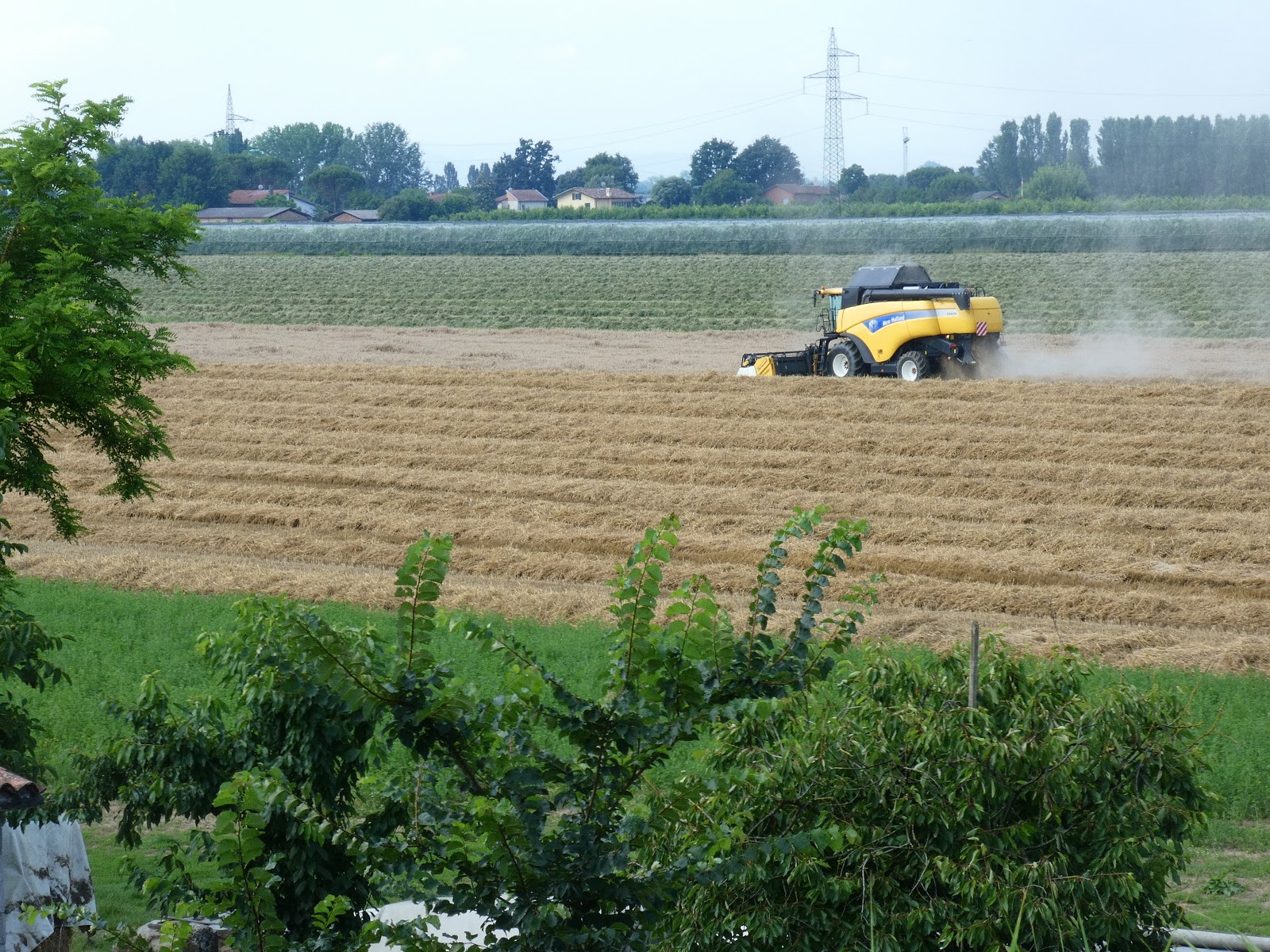
Our journey to Forli was pleasant, but VERY hot.  The path more or less followed the Ronco River.  For most of the way it followed the levee bank, which combined as a cycle track and an access road for vehicles from the houses on the lowland side.  We were pleased when we fluked a bit of shade, but as the day wore on the shadows got shorter and we had to criss-cross across the track to make the most of what little there was.  There were few towns to divert to get a cold drink and so it was a case of putting one foot in front of the other and plodding on.  It was hard to find shady places to rest and to eat.  We grabbed the little patches we could find and rested briefly, taking off our boots to air our feet as the hard asphalt of the cycle path was tiring on the feet.


 Green crops, and crops ready to be harvested
Yet to be harvested crops......
....and the harvesting in progress.

Despite that we had a couple of interesting diversions.  One occasion was when we stopped to “perch” on a guard rail for a rest and a cycle tour shared our pathway.  There were about 30 of them, Italians, based in Ravenna and going out each day on a ride.  We questioned them, and they questioned us!

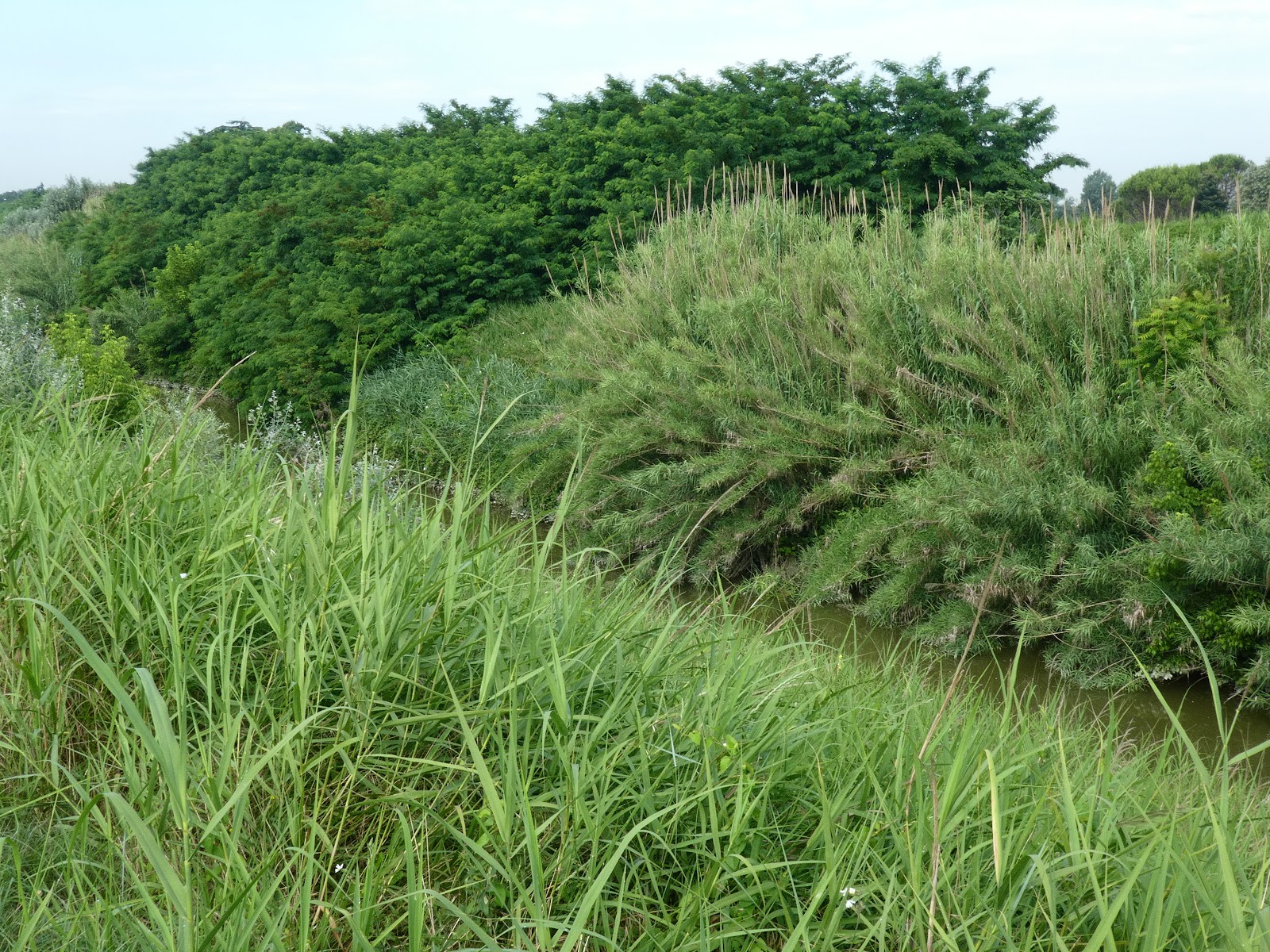
I was quite surprised by the density of the bush lining the river.  Very thick and lush, though the water level in the river was fairly low, with the river being used for irrigation of the crops.  Both agriculturally and horticulturally the way was quite diverse.  We passed cereal crops, some being harvested, fields of clover, stone fruit crops, apples and cherries, kiwi fruit, and vines. 
 The lush river undergrowth
 Just some of the cyclists we met at our "perch" point!

With the heat, neither Jill nor I felt like walking through the suburbs, and so just outside of Forli we crossed the river and hopped on a bus to get through the suburbs.  Unfortunately our accommodation was quite a distance from the centre of town so we still had quite a hike.  After washing ourselves and our clothes we walked into the centre of the city to have a look around a very interesting town.  After drinks and a snack in the Piazza Saffi Aurelio we went across the massive square to look inside the Church of San Mercuriale, the oldest Church in the town.  The windows were of alabaster and sith the sun shining through them the whole building was suffused with a yellow light as if the spotlights were on. 
Piazza Saffi Aurelio
Abbey of San Mercuriale...
                         
For the first time we had fun and games finding somewhere to eat that night.  This was the place where we couldn’t find a restaurant that opened before 7.30!  We were very hungry and very tired and so we wanted to eat early and get some rest, but it wasn’t to be. 

Tuesday, 19 June 2018

Mosaics, music, & meanderings in Ravenna – Day 81, 82, & 83 “resting” on the Via.


Well what a time we have had here in Ravenna, a lovely town, and what beautiful things to see.  We have done so much that what I am about to show and tell you is only a small portion of it.  There is  plenty of information available if you wish to research more about this amazing place and its treasure trove of mosaics. 

We began our stay here by booking a guided tour of the Mosaics.  Ravenna has many UNESCO World Heritage sights, 5 of which are particularly famous for their beautiful mosaics.  Our guided tour took us to 3 of these sights and an extremely knowledgeable guide put us into information overload with all she knew about the history of the mosaics and of her town.  Mind you, both Jill and I decided that we got the abridged version in English while the Italians got a more extended one!
                         
The first church we saw as we entered Ravenna.  This church was almost completely destroyed in a bombing raid in WW2.  Fortunately some of the mosaics were saved.

We began our stay here by booking a guided tour of the Mosaics.  Ravenna has many UNESCO World Heritage sights, 5 of which are particularly famous for their beautiful mosaics.  Our guided tour took us to 3 of these sights and an extremely knowledgeable guide put us into information overload with all she knew about the history of the mosaics and of her town.  Mind you, both Jill and I decided that we got the abridged version in English while the Italians got a more extended one!  I am going to let the pictures talk – and believe me, they don’t talk anywhere near as well as the real thing.  We went to each sight twice, and so got some quality time to view and marvel at the detail of them.
Basilica di Sant’Apollonare Nuovo, Ravenna, and the mosaics inside (below).


Basilica di San Vitale and its wonderful mosaics (below).


Mausoleo di Galla Placidia (in the same grounds as San Vitale)


The octagonal Arian Baptistery 


Because the ground is so soft (I think that is the explanation), many, or maybe all, of the buildings we saw had double capitals.  This is quite a feature of the buildings and was pointed out several times to us.


We investigated places like the Basilica di San Francesco.   Tis is a beautiful simple church with an interesting wooden roof.  There is a chapel at the side which has a model of a monk standing in it.  This is a model of an extraordinary man – San Massimiliano Kolbe who volunteered to take the place of a family man doomed to die in Auschwitz.  His statue has eyes that follow one around, and indeed I thought it was a real person standing there for a while, as did Jill.

Here we saw the crypt, but didn’t go into it – it has a metre or more of beautiful clear water in it, complete with gold fish.  The city of Ravenna has been built on reclaimed swamp, and the water in the crypt is the level of the water table.  Indeed two other buildings had similar evidence of the water table.  Another church which had been severely damaged in a bombing raid in WW2 had a big hole and a spotlight showing the water next to a pillar, and the Basilica San Vitale had a well in it, again, with crystal clear water.  This well was where Saint Apollinare was murdered.  He was put in the well and smothered by rocks – a grizzly end!


The Music!  After finding our apartment, our first stop was the tourist bureau.  Here we learned about a concert that was to be held that evening in Basilica San Vitale.  It was to cost the grand total of €1 each and so of course this was an opportunity  not  to  be  missed!   To sit in that magnificent building with it's wonderful acoustics, looking  at  the  mosaics (for €1!!), and hearing beautiful  medieval music was a treat indeed. We saw one of the artists twice, a duo consisting of a soprano (Elisabeth Hetherington) and Lute (Liuto – David Mackor).  The first performance was a programme of medieval church music written by several nuns of the time, and the second was, again, medieval music with a special singing technique called monody.  This programme consisted of music by Giulio Caccini, as well as with several pieces composed by his daughter Francesca.


We went to two other concerts, one was Stabat Mater by an Neapolitan composer, Girolamo Abos, and performed by a female choir accompanied by a string trio plus a small organ.  The highlight of the concerts though, for me, was the final one.  This was a duo programme of the small organ (played by Nicola Lamon, the same organist as the previous night) and a cornetto – no, not the ice-cream, but a medieval wooden instrument that somehow sounded like a cross between a recorder and a trumpet!  The music was by Gabrielli and his contemporaries.  It was fascinating to hear this instrument which composers of the time described as the closest instrument to the human voice.  The musician (David Brutti), who I think first studied the saxophone, plays this instrument at the side of his mouth, though it has a reed of some sort – or some such device.
      
Nicola Lamon (left) & David Brutti (right)

      
Three of the four Cornettos played (left), and the delightful organ (right).  It packs some punch with volume and as far as I could make out only has 4 stops.

As part of our meanderings we visited an amusement park – by mistake!  We thought the bus driver would stop for us as we had no idea when to press the button.  We drove past it, but rather than stop and walk back in the hot sun we continued to the end of the line where the bus disgorged its load of teenagers off for a day of fun and water activities.  We sat on the bus and returned to where we intended to go.   Apart from wandering all over the city, our meanderings took us to Classe where we saw yet more mosaics in the Basilica di Sant’Apollonare.  This church is also a UNESCO world heritage listed building, and we were glad that we made the decision to go.
      
Inside (below) and outside (above) the Basilica di Sant’Apollonare in Classe.  A beautiful building indeed.


We had a delightful time in Ravenna exploring the city, seeing the sights, and testing out various restaurants and gelataria.  We have walked today from Ravenna to Forli, but more of that next time.

Sunday, 17 June 2018

Ferrara, Traghetto, Argenta, Casalborsetti (via Ravenna) – Day 77, 78, 79 & 80 on the Via Romea


As I mentioned last time, I had to consider catching a train to make up some time.  When it came time to leave Quarti I decided that it would be prudent to do just that.  My feet were a bit sore from the previous solid day’s walking, it was going to be hot, and my friend Jill was waiting in Ferrara for me.  My host kindly offered to drive me (backwards) to Rovigo where I could easily catch a train and so we set off in the early morning for the train station.  What took me a whole day to walk the previous day, took less that half an hour to drive, and I caught the train within 15 mins!

It was really good to catch up with Jill in Ferrara.  We got ourselves organised and spent a considerable time sitting watching the bikes go to and fro.  Despite the fact that I have been through many towns where the residents ride bikes of all types Ferrara still wins as “bike city”.  While in Ferrara I had several meals of my favourite pasta – pumpkin cappalletti with butter and sage!  It is delicious and I have fond memories of this dish from the last time I was in Ferrara. 

We both had excess baggage, and I came up with the idea of sending some stuff ahead to save the weight in our packs.  After being seriously callous with what we would need for the next stages we trotted off to the post office and offloaded (over the course of an hour - you can’t hurry things here) almost 4 kgs of extra gear  – clothes, and in my case pamphlets – into a big box which Jill will collect at her hotel in Rome and take home with her.  The difference in weight for me has been wonderful, and I think Jill was pretty pleased too. 
Bikes parked at the train staion
Sharing our first meal on this journey.  Jill (right) and I about to tuck into our pumpkin cappalletti 
Pumpkin cappalletti - delicious!
      
Ferrara, and its buildings.
                         

We left Ferrara a little later in the morning than we intended and spent the day walking towards Traghetto in VERY hot conditions.  We chuckled as we walked towards the heavy bike traffic of commuters heading into the city for work, we grumbled as we walked along a busy road with very little verge, and we were very grateful whenever we found a patch of shade to rest in.  We were meant to get to Traghetto on this day, but when we got as far as Marrara where we called our hostess for the night and she came and collected us in the car.  What bliss – a lovely comfortable room, an offer (gratefully accepted), of washing our clothes in a machine, and driving us to a pizzeria to collect a takeaway pizza.  Theresa even made us a salad to have with the pizza.  Real service. 
About to set off for the first day's walk
Heading out of  Ferrara. You can see the tiny sign we follow on the pedestiran post.
It was so hot my umbrella went up!

The following day to Argenta was a different story.  Shade most of the way, a cafe to stop for a rest, and even a rest stop complete with a “seat”!  Actually it might have been a roadside bench for putting fruit and vege on for sale – but there was nothing there and it was a perfect rest stop - so we sat!  We had a room right in the centre of town in Argenta and we arrived early enough to wash and go out for aperitifs before dinner.  
      
On the way to Argenta we passed some interesting gateposts marking the entrance to some derelict buildings (above left), and just part of the shady path we walked on (above right)
As we approached Argenta, we kept a keen eye on the approaching storm.
      
Brightly coloured buildings entering Argenta, and the bell tower in the town

We changed our plans for the next day though, leaving our packs at the hotel and walking around the Valli di Comacchio, a place laden with bird life – AND – king sized mosquitos!  There had been a big thunderstorm in the early hours of the morning and so the humidity was pretty high, as was the mud in one place, but a truly beautiful park, and well worth visiting, despite the mud that made us a few inches taller.  We then returned to the hotel, collected our packs and headed to the train station where we caught the train to Ravenna. 
 The start of the Valli di Comacchio, with just some of the birds we saw.
      
 Pieve di San Giorgio.  Note the poor man being turned on the wheel above the door!


The mud

By doing this we have been able to have 5 nights in the one place, walk pack free for another day.  After a night in Ravenna, and more of that later, we set off early the next morning by bus to Casalborsetti.  This is a town on the Adriatic coast – the first sight of ocean / sea for me since departing.  After a coffee and brioche on the waterfront, and many photos we set off, first through a park, then a diversion out to the beach so that we could walk along the coastline – I won’t call it a beach, because there were not too many places that had access to expanses of sand, and many places where giant rocks were the place of choice for sunbathing.  That word, sunbathing, gets me started!  I do not understand peoples attitude here in Europe to the sun.  People say it is not as bad as in Australia, but believe me it has a lot of punch in it, and I am sure could cause a lot of damage.  Perhaps when melanomas start increasing people might take more care.  We passed many people who were very brown, skin starting to look very leathery, and yet they still lay out in the hot sun.  My shirt is testimony to the effects of the sun as it is distinctly striped where the sun has faded the exposed parts of it, yet here there seems to be little concern about skin cancers.  We are the oddities, walking in long trousers / shorts, long-sleeved shirts, and a big hat on our head.  The locals on the beach were in the briefest of clothes and often without any hats. 
 The beach at Casalborsetti (above and below) ......   

     
 ....... and then further along the coast line.
 The Adriatic Sea, oil rigs on the horizon.
 The brolly goes up, presumably to provide shade for the bags and towels, and then the chairs are placed in the sun for people sit, while their belongings are protected from the sun!!

After our brief “beach” experience we returned to the path which, after a spell running along a canal,  went for about 8kms through lovely bush with lots of pines known as Pineta di San Vitale.  It was here that the monks from the Abbey in Ravenna made herbal remedies and stored pine nuts.  We were chuckling as we walked because the notes said that we would enter two clearings.  The second one was a “vast clearing, where one can meet horses”, and then we were to continue on this “earthly paradise”!   We did come across a “herd” (about 20 of them) of horses, though they didn’t shake hands when we met, they were VERY curious about us.   It was lovely, but again, we had to be careful of the mosquitos which were plentiful due to the reasonably stagnant water in the canals we were passing.  It was really interesting for me seeing the fishermen’s cottages along the canals, just prior to the forest.  It is here in this region that the fishermen use big nets that they lower into the water, then lift out, by a pulley system.
 The nets used by the fishermen (above & below)

 Lots of still water for mozzies to breed in!
      
 The path in Pineta di San Vitale and the “vast clearing” where we saw the horses.  They showed and instant interest in us from when they heard us approaching.  They did want to greet us, but were soon more intent on grazing.  We have no idea who they belonged to how they are looked after them.  
      

 As we approached Ravenna we had to cross the dodgy bridge, complete with a big gap between the edge and the pipeline - big enough to fall through.  It was either walk on this or cross the bridge with fast, heavy traffic crossing the bridge.  

We arrived in Ravenna for the second time passing the first of the UNESCO monuments we were to see throughout our time in the beautiful city.  This was the Mausoleum of Theoderic, the Ostrogoth King who lived 454 - 526 from and reigned in Ravenna for the last 30 years of his life.  He himself ordered that his mausoleum be built in 520.  This is quite an amazing building when one considers when it was built.  It is decagonal, and the roof is made from a single stone weighing almost 5 tons and 11 metres in diameter.  It was built from Istria stone and was, in its day, the only building in Ravenna not made of bricks.  
The Mausoleum of Theoderic

After our visit to the Mausoleum we headed the last kilometre or so to our room and were glad to have a shower – and rest.  Though we didn’t do much of the latter, but more of that in the next post.